
How StrataVoter keeps votes fully anonymous
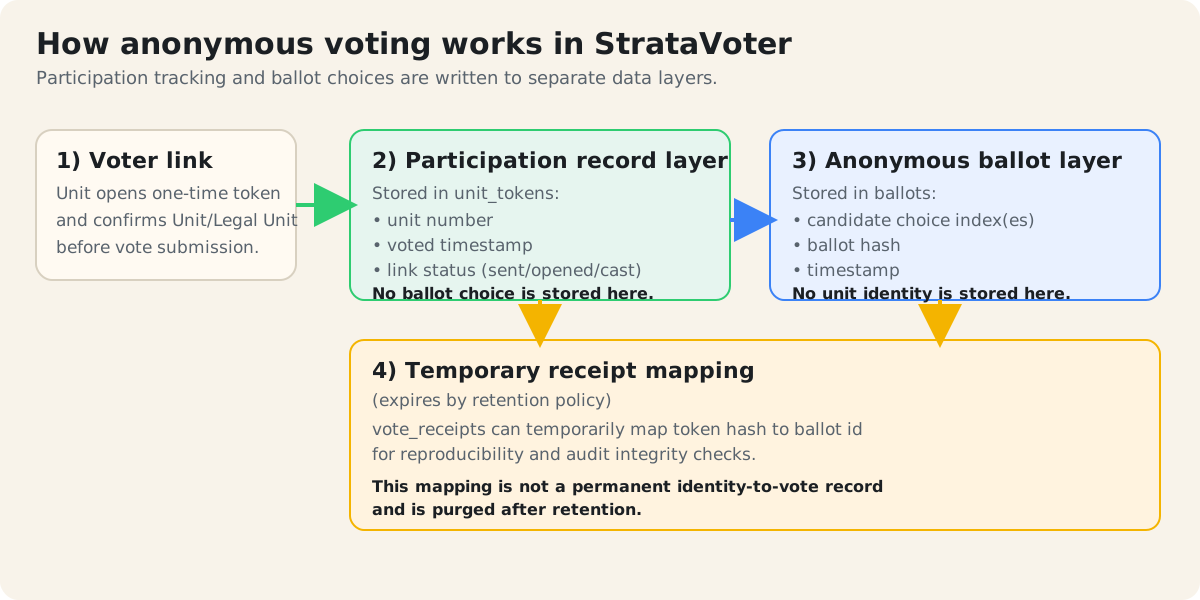
In plain terms: the system tracks that a unit voted, but stores the ballot choice in a separate record with no unit identifier. That means there is no direct lookup from a unit to a selected candidate.
Simple explanation
- Each eligible unit gets a one-time voting link.
- When a vote is submitted, the link is marked “used” for quorum tracking.
- The vote itself is written to an anonymous ballot table that does not contain unit number or owner identity.
- A temporary receipt mapping exists only for audit reproducibility and expires under the retention policy.
Security and Canadian data residency
Your data is protected with end-to-end encryption - secured both while it’s being transmitted and while it’s stored. All voting information is housed in a dedicated Toronto, Ontario data centre, ensuring it stays fully within Canada. Although the application interface may be streamed from other regions for speed and reliability, the actual voting data never leaves Toronto. This architecture allows us to provide fast access while maintaining strict data residency and privacy standards.
Anonymous voting data-separation diagram
This flow shows how participation visibility is kept separate from ballot secrecy.
Technical model
| Data store | Contains | Does not contain |
|---|---|---|
unit_tokens |
Unit number, token hash, voted timestamp | Ballot choice |
ballots |
Choice index(es), timestamp, ballot hash | Unit number or owner identity |
vote_receipts |
Temporary token-to-ballot linkage for reproducibility | Permanent identity-to-vote mapping |
Compliance and retention
StrataVoter retention is configurable per election (default 90 days) and deletes election data after closure + configured retention window.
All vote records are stored anonymously by design, with encryption at rest and encryption in transit (TLS), using controls designed to align with strict PIPEDA and GDPR expectations for protecting personal information.
“For a record described in paragraph 10 of subsection 55 (1) of the Act, at least 90 days following the date of the meeting ...” — O. Reg. 48/01, s.13.1(2), para.3
Privacy standards for PII (Canada, USA, Europe)
| Region | Reference standard | Quoted requirement focus |
|---|---|---|
| Canada | PIPEDA, Schedule 1 (Principle 4.7 Safeguards) | Organizations must protect personal information with safeguards appropriate to the sensitivity of the information. |
| USA | FTC Safeguards Rule (16 CFR Part 314) | Covered organizations must develop, implement, and maintain a comprehensive information security program with administrative, technical, and physical safeguards. |
| Europe | GDPR Art. 5(1)(f) and Art. 32 | Personal data must be processed with appropriate security, including protection against unauthorized processing and use of technical measures such as encryption. |
Compliance obligations vary by deployment context and customer configuration.